
The IT outstaffing model: an approach to hiring remote talent you'll want to try

In the late 90s, the business world faced a new fast-growing trend — outsourcing. The American tech industry pioneered in trying out the new approach to doing business with the help of third-party vendors. Since then, nearshore and offshore partnerships have been getting increasingly common for both big corporations and small startups.
Cost efficiency was the main reason to take the outsourcing route in the past. But as time went by, the classic outsourcing model as we know it today started to show flaws. Low code quality, poor motivation and understanding of business specifics among outsourcing vendors’ employees, missed deadlines, inflated budgets, and unpredictable end products were among the most common claims.
And then, the outstaffing model came to the scene as a new method of hiring remote talent. While still technically outsourcing, outstaffing gives the client more control over the product by allowing them to manage remote workers directly. Within the tech industry, the outstaffing model is commonly used by SAAS companies, tech startups, middle-sized businesses, and global corporations.
What does outstaffing mean and how does it work?
Outstaffing is a type of indirect employment in which TalentKeeper X provides the services of staffing, retaining and overseeing full-time talent for Company Y. TalentKeeper X also covers legal aspects of cooperation, provides work space and IT support to the outstaffed team members, pays their salaries, recruits new talent, and conducts HR processes.
In America, outstaffing typically goes under the name of "contracting," in Europe — "subcontracting," or "offshoring," in Australia — "talent outsourcing" or is described as "hiring a contract worker." The very word “outstaffing” comes from a combination of words "outsourcing" and "staff."
Let’s take a look at a hypothetical situation. The CEO of NorthDevTech, a Netherlands-based tech company, decides to hire a team of specialists located in an Eastern European country. After researching online and talking to fellow business owners, they decide to partner with TalentPro, a company specializing in staffing clients’ teams with local specialists. NorthDev sends TalenStaffingtPro detailed job descriptions and requirements for their open positions. TalentStaffingPro proceeds to find fitting candidates, who NorthDevTech interviews and then approves the ones they like best. The latter sign contracts with TalentStaffingPro, while TalentStaffingPro signs a contract with NorthDevTech. This way, NorthDevTech indirectly hires full-time talent that is technically employed by TalentStaffingPro. As a result, the Dutch company extends its team with subcontractors located abroad.
Alternatively, within classical outsourcing the client partners with an outsourcing vendor that takes full responsibility over managing talent and implementing the project. That’s why outsourcing rates include the cost of daily team management, overheads that the vendor uses to cover the salaries of other employees, and risk management. This explains why, on average, outstaffing rates are 20 to 30 percent lower than outsourcing rates.
Core outstaffing benefits — what companies find it most useful?
One of the main benefits of outstaffing is that it can cover the growing talent shortage haunting the tech industry. IT outstaffing best suits those tech companies that want to extend their existing tech team quickly and want to keep ultimate control over their talent and projects.
In the best-case scenario, the client company has tech expertise on its side to manage the extended IT team, while the outstaffing service provider facilitates everything else. However, it’s not uncommon for companies to hire project managers together with the remote team through an outstaffing vendor.
The crucial difference between the IT outstaffing model and the IT outsourcing model is that in outstaffing, the client directly manages the distributed team and has full responsibility for timely delivery of the product and its quality.
In outsourcing, the technical vendor takes care of managing the team as well as all the required planning and tracking activities that should lead to the successful delivery of the product. The vendor manages the tech team on a daily basis. In the majority of cases, the vendor will staff the team with their existing engineers.
What are the advantages and disadvantages of the outstaffing model?
| Advantages | Disadvantages |
|---|---|
| Advantages | Disadvantages |
| The client doesn’t need to look for remote tech specialists themselves. The vendor staffs the client's projects with their own tech talent on a subcontractor basis. The client doesn’t take care of payroll and employment taxes of the remote employees on their team. | Outstaffing typically requires tech expertise on the client’s side, although tech management can be outstaffed as well to assist non-tech companies in building and maintaining their products. |
| Rates are lower than within the outsourcing model as they exclude the cost of risk management and overheads. | The client has full control over the workload of the outstaffed team. Consequently, the responsibility for successful and timely delivery is the client's, not the vendor’s. |
| The outstaffing vendor covers administrative processes such as payroll, recruitment, etc. allowing the client to concentrate on managing the product delivery team. | In order to be satisfied with the workload/developers’ seniority/costs, the client has to pay special attention while choosing candidates for their projects. |
Do you have any additional questions? Or looking for team augmentation?
Let's talk!How does the IT outstaffing model help to optimize development costs?
Within the outstaffing model, you can have a remote team without opening a new company branch or a remote development office. As a client, you don’t need to hire recruiters, lawyers, accountants, and facility managers — they’re already a part of an outstaffing vendor and will take care of operational work. Meanwhile, you can implement your internal corporate policies and culture using the existing infrastructure and expertise of the outstaffing provider.
Now, let's look deeper into what the outstaffing cost consists of. It’s hard to calculate the average rate of an outstaffed tech worker as the rates vary from specialist to specialist. Nonetheless, the outstaffing cost structure remains transparent: it includes a developer's net salary and the vendor fee.How IT outstaffing model optimizes development costs
An outsourcing company is responsible for the delivery of the end product. That’s why the outsourcing cost structure includes additional costs of managing risks related to successful delivery. Also, outsourcing rates inherently cover expenses associated with non-technical talents such as business analysts and project managers. Developers' net salary doesn’t differ much from one outsourcing company to another, but it exceeds in total price due to overheads.
Process of cooperation with an outstaffing company
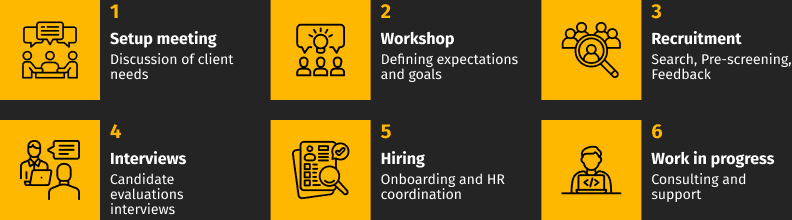
Phase 1. Setup meeting: discussion of client needs
- Basic requirements discussion
- Preparing a team for an in-depth discussion
The first phase of collaboration begins right after the client chooses an outstaffing vendor and makes initial contact. During the opening phase, the client tells about the basic needs of the company, and the vendor says which of those can be covered by their means. For instance, the client can require engineers for product support or for an entire product buildup from scratch. Depending on the case, the vendor prepares a team for the next stage — workshop on defining the client's business.
Phase 2. Workshop: defining expectations and goals
- Reviewing current priorities, processes, documentation
- Defining team composition
Traditionally, an outstaffing agency gathers an operations team that includes necessary specialists such as, for instance, recruiters, HR managers, competence leads, and a top-management representative. The team delves into business processes, corporate culture, tech team composition, roles distribution, product development plan, and functional requirements of the product.
As a result, the outstaffing vendor knows how the client's business functions, what the expected result is, and what tech talent should be hired to fulfill the goal. If necessary, the vendor consults the client on the optimal team size and composition.
Phase 3. Recruitment: search, pre-screening, feedback
- Outstaffing company’s recruiter shares relevant CVs
- Pre-screening calls to define candidates’ experience and motivation
Next, the recruitment process is held on the side of the outstaffing vendor. Their recruiter uses candidate portraits and makes pre-screening calls with suitable candidates. When a candidate matches the corporate culture of the client and their experience is relevant, the recruiter sends their CV with comments to the client and waits for feedback.
Quick response is crucial at this phase, as the client and the recruiter have to synchronize their vision on the prospective team member. It’s worth mentioning that in outstaffing, each tech engineer is recruited exclusively for the client, not taken from the bench. As a result, the client gets a perfectly-matching team member with the right type of expertise.
Phase 4. Interviews: candidate evaluation interviews
- Feedback from client to recruiter
- Feedback about candidates
- Client evaluates soft and hard skills of a candidate
After the client shares their thoughts on the CVs of potential team members and approves some of them for further communication, the recruiter schedules calls with the selected candidates. Traditionally, candidates go through two interview rounds. The first one is a soft skills assessment session. It’s conducted by the client’s managers with an aim to see the cultural fit of the candidate.
Then comes the time for a technical interview with the client’s tech leads. If an interview isn’t enough to make a final decision, clients give tests to ensure the suitability of the candidate.
Phase 5. Hiring: onboarding and HR coordination
- HR manager introduces all communication channels
- Making sure newly hired engineers understand their roles and tasks
- Settling all processes, giving accesses, arranging workplaces
When the client decides to hire any of the interviewed candidates, and the candidates accept job offers, the outstaffing company’s facility manager starts preparing the hardware and software for the new employees. At an established outstaffing company, a newcomer will have everything prepared for the first day of work and will go through the onboarding process.
The outstaffing vendor facilitates the communication between the sides by introducing HR or account managers, lawyers, accountants, and other relevant specialists. At this point, a smooth and quick onboarding process is key to success. An HR manager has to make sure that the newly-hired engineer understands their role, has all the accesses, and can use all the communication channels.
Phase 6. Work in progress: consulting and support
- HR consulting, performance reviews
- Client manages team directly; rate reviews
During the active collaboration process, the client and the outstaffing vendor have mid-term sync-up calls and share feedback. The client can also consult with the vendor about the practical questions such as remuneration or processes set-up.
What is the role distribution in the IT outstaffing model?
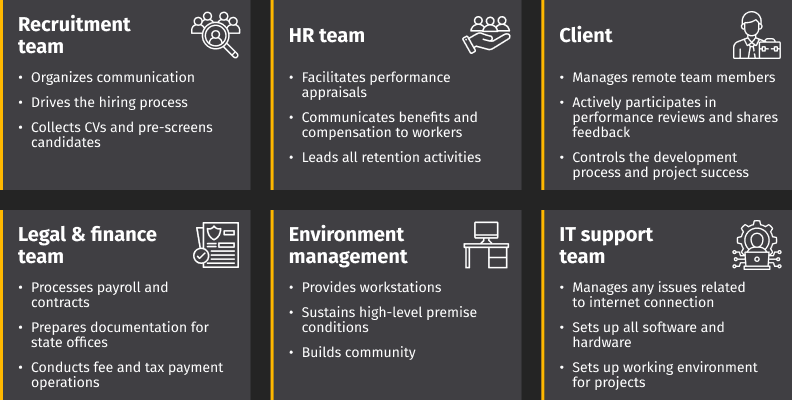
The outstaffing model requires active involvement of both parties. The client has to actively manage their remote dedicated team, meanwhile, the outstaffing agency concentrates on providing a comfortable environment for work and growth.
How to choose an outstaffing partner?
Choosing an outstaffing partner is easy when you know what to ask. We’ve highlighted the three major aspects you should take into account when choosing an outstaffing vendor.
| Years on the Market | Certificates and Recognitions | Personal Impression About Service Provider |
|---|---|---|
| Years on the Market | Certificates and Recognitions | Personal Impression About Service Provider |
| A company with 5–10 years on the market is more likely to have a bigger pool of tech talent and a strong employer brand. Tech talent is the core element of the outstaffing model, and attracting top developers is of paramount importance for any vendor. | Certificates and recognition awards indicate whether an outstaffing company is competent enough to provide services of high international standards. Moreover, certificates show that a company invests in professional growth of their employees. | You can often tell whether a company is good at communicating from the first contact you have with them. As a client, you should pay special attention to the way potential outstaffing partners respond to any of your questions or requests. |
AI Engineering is Grid Dynamics' dedicated unit serving small and medium-sized businesses across Europe. While Grid Dynamics empowers Fortune 1000 companies with 19+ years of enterprise technical consultancy, AI Engineering brings that same enterprise-grade expertise to the European SME market delivering custom AI development services and IT staff augmentation services purpose-built for growing businesses. Our clients enjoy the flexibility of choosing engagement models tailored to their needs, such as team extension, and dedicated teams.