
Conquering the customer: customer personalization in the beauty industry
 Cristian Scorohodco
Enhancing engagement, conversion and revenue with AI
The beauty industry sits at the intersection of two powerful forces. Consumer expectations for personal, relevant experiences have never been higher, and advances in artificial intelligence have finally made those experiences deliverable at scale. AI has moved from an experimental add-on to a core engine of how leading beauty retailers acquire, convert and retain customers.
Beauty is a deeply personal category. Skin type, undertone, hair texture, concerns, routines and budgets differ from one customer to the next. Yet most beauty e-commerce experiences still treat the first-time visitor, the loyal repeat buyer and the lapsed customer in the same way. That gap between how personal the category is and how generic the experience feels is where engagement, conversion and revenue quietly leak away.
Let's explore how AI-driven micro-segmentation and personalization close that gap at every step of the customer journey: from the anonymous first click to the authenticated repeat purchase, across browse, add to cart, checkout and post-purchase. We will focus on four capabilities that do most of the work, on the data you already collect to power them, and on what success looks like once they run together.
Key takeaways
- Personalization is no longer a differentiator in beauty. It is the baseline customers expect. McKinsey reports that 71% of consumers expect personalized interactions and 76% are frustrated when they do not get them.
- Done well, personalization drives a 5 to 15% revenue lift and 10 to 30% greater marketing-spend efficiency, according to McKinsey, led by product recommendations and triggered messages.
- The raw material is data you already hold: anonymous browsing behavior, favourites, cart contents and purchase history.
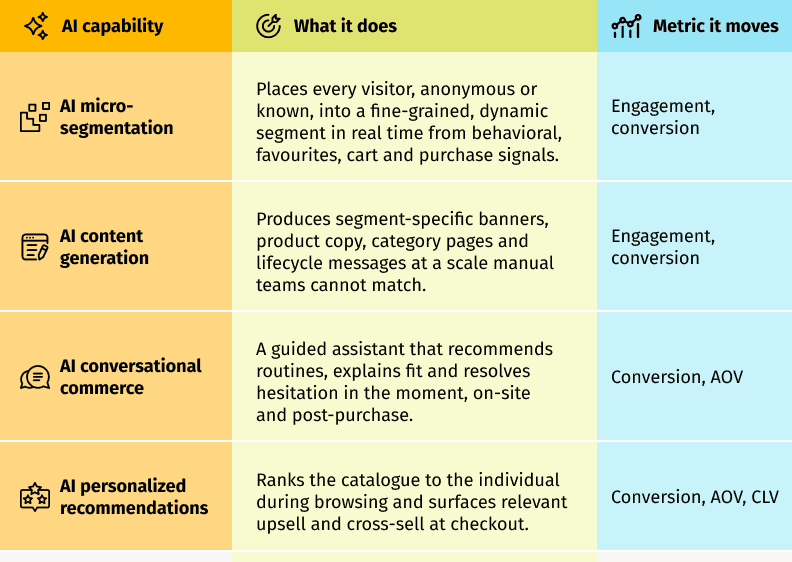
- Four AI capabilities carry most of the value: micro-segmentation, content generation, conversational commerce and personalized recommendations.
- The cart is the single biggest opportunity. Roughly 70% of online baskets are abandoned (Baymard Institute), and a large share is recoverable through smarter, more personal checkout.
Personalization is the new baseline, not the differentiator
Customer expectations have moved. McKinsey's research shows that 71% of consumers now expect companies to deliver personalized interactions, and 76% get frustrated when they do not. In beauty the expectation is sharper still, because product fit is individual and the cost of a wrong recommendation is a returned item and a lost customer.
The commercial case is equally clear. McKinsey finds that personalization leaders generate a 5 to 15% lift in revenue and 10 to 30% improvement in marketing-spend efficiency, achieved predominantly through product recommendations and triggered communications. The same research shows faster-growing companies derive significantly more of their revenue from personalization than slower-growing peers. For a beauty retailer paying rising acquisition costs, converting more of existing traffic and keeping more of existing customers is the most rational growth strategy available.
Personalization runs on data you already collect
Effective personalization does not require buying new data. It requires using the data already flowing through the site, organised into a single view of the customer. Four layers matter most:
- Anonymous behavioral data: referral source, search terms, category affinity, products viewed, dwell time and device, all available before a visitor logs in.
- Favourites and wishlist data: explicit signals of taste and intent that turn a rough segment into a precise one.
- Cart data: what the customer is considering right now, basket composition and price sensitivity.
- Purchase history: what worked, replenishment cadence, routine composition and lifetime value.
In the EU, treating this as first-party, consented data is both a regulatory requirement under GDPR and a durable competitive asset. The retailer that earns opt-in and keeps the data clean owns a signal that paid media cannot replace.
The clearest way to see the opportunity is to follow a customer from the first anonymous click to the repeat purchase, and to ask what better personalization changes at each step.
Anonymous browsing: segment from the first click
Personalization can begin before login. Within seconds, behavioral signals place a visitor into a micro-segment: the referral source, the first product views, the search query, the device. AI micro-segmentation replaces a handful of broad personas, such as skincare buyer, with hundreds of fine-grained, dynamic segments, such as fragrance-curious, gift-shopping, price-sensitive, mobile, first visit.
That segment then drives what the visitor sees: the hero banner, the order of the product grid, the editorial content and the promotion. AI content generation makes this economically viable, producing segment-specific banners, copy and category pages at a scale no manual team could sustain. AI-based recommendations rank the catalogue to the visitor in front of you rather than to the statistical average.
The authenticated shopper: from favourites to a routine
Once a customer logs in, favourites and purchase history sharpen the segment into something genuinely individual. This is where a conversational commerce assistant earns its place: it can ask about skin concerns, propose a complete routine, explain why a product suits the customer, and answer the questions that would otherwise send the shopper to a search engine or away from the site entirely.
Beauty retailers have shown what this looks like at scale. Sephora's guided-discovery and virtual try-on tools are widely reported to have lifted engagement and conversion by helping customers choose with confidence. At this stage, recommendations shift from people also bought to completes your routine, which is both more useful to the customer and more valuable to the retailer.
Cart and checkout: protect the basket and raise its value
The cart is where purchase intent is highest and leakage is worst. Roughly 70% of online baskets are abandoned, according to the Baymard Institute, and Baymard's testing shows that a substantial share is recoverable through better checkout design. Personalization adds two levers on top of good design.
First, smarter upsell and cross-sell. A relevant add-on, the matching primer, a travel size, a refill, raises average order value without feeling pushy, because it is anchored to what is already in the basket. Second, a conversational assistant can resolve last-minute hesitation in the moment: a shade question, an ingredient concern, delivery timing or the returns policy. The target for this stage is simple: one relevant add-on, and zero unanswered questions.
Post-purchase: turn one order into a relationship
The post-purchase window is the most under-used stage in beauty. Purchase data reveals replenishment cadence, gaps in a routine and the natural moment for the next order. AI can time a replenishment reminder to when a product is likely running low, recommend the logical next step in a routine, and generate personalized education on how to use and what to pair, which builds the habit.
This is where customer lifetime value compounds. Personalization is most effective at driving repeat engagement and loyalty over time, and retaining an existing customer costs far less than acquiring a new one. A first order is a transaction. A well-handled post-purchase journey is the start of a relationship.
The four AI capabilities behind it
Where to start
Personalization rewards a sequenced approach, not a big-bang launch. A practical order of operations:
- Start with the data you already own. Audit anonymous behavioral, favourites, cart and purchase data, and unify it into a single customer view before buying new tools.
- Pick one journey stage with a clear metric. The cart is usually the highest-leverage place to begin.
- Treat consent as a feature. Collect first-party, opt-in data transparently. It is both a GDPR requirement and the foundation of durable personalization.
- Begin with recommendations and triggered messages. McKinsey notes these are where personalization leaders capture their first gains.
- Measure incrementally. Use holdouts and A/B tests so the revenue lift is provable to the CFO, not assumed.
- Scale to full micro-segmentation and conversational commerce once the data foundation and measurement discipline are in place.
What success looks like
The four capabilities are not independent tools. They compound. Sharper segmentation makes recommendations more relevant, more relevant recommendations lift engagement, higher engagement feeds conversion, and a guided checkout protects and grows the basket. When the full set runs as one connected system, the effect shows up across four core metrics.
Engagement improves first. Micro-segmentation and AI-generated content make the opening screens relevant from the first session, which lifts pages per session, time on site and the rate at which visitors return. A conversational assistant deepens this by turning passive browsing into a guided conversation about routines and concerns.
Conversion follows. Personalized recommendations help more browsers find a product that fits, and a guided, reassuring checkout resolves the hesitation that drives roughly 70% of baskets to be abandoned. More of the traffic the retailer already pays for turns into orders.
Average order value rises next. Recommendation-driven upsell and cross-sell, anchored to what is already in the basket, builds larger, routine-based orders without discounting. The matching primer, the travel size and the refill add margin rather than erode it.
Revenue and customer lifetime value are the compounding result. Revenue per session is the product of conversion and order value, so independent gains in each multiply rather than simply add. Post-purchase personalization then lifts repeat-purchase rate and retention, which compounds lifetime value over the following quarters.
The table below summarises what beauty retailers can reasonably expect from a full-featured personalization setup.
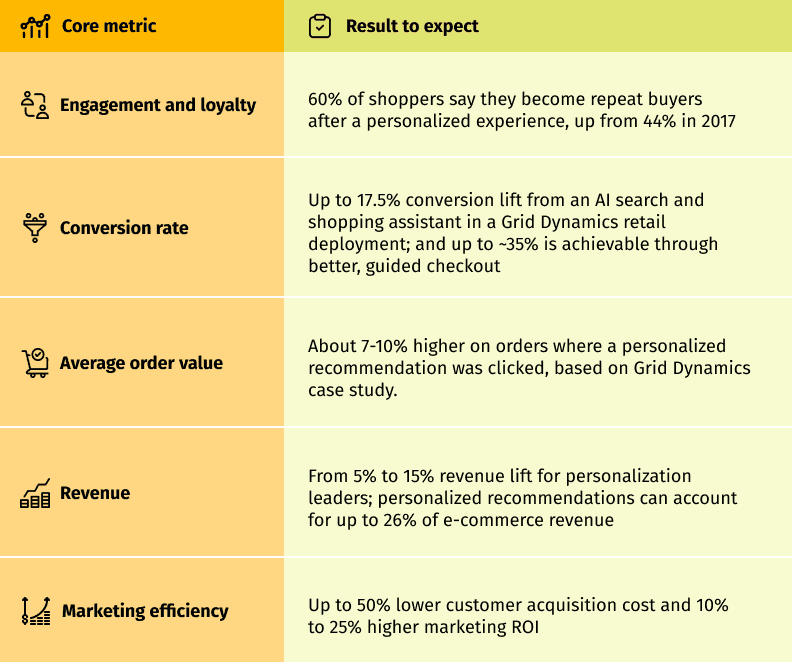
As an illustration, a retailer with a 2% conversion rate and a 60 euro average order value that improves conversion by 6% and order value by 5% through these capabilities would generate roughly 11% more revenue from the same traffic. That sits inside the 5 to 15% revenue lift McKinsey associates with personalization leaders, with retention gains compounding lifetime value on top. The figures presented above bring a ballpark range for orientation purpose, while actual impact depends on the starting baseline, category mix and execution discipline, which is exactly why measuring incrementally from day one matters.
A case study: AI search and shopping assistant
The figures above are not theoretical. Grid Dynamics built an AI search and conversational shopping assistant for a luxury omnichannel retailer that wanted online discovery to feel as guided as an in-store consultation. The system pairs fast facet search with a conversational assistant that interprets complex natural-language queries and personalizes results across search, browse and recommendations. It runs on Google Cloud's Vertex AI Search for Retail and Gemini models.
The reported outcomes were a 9% conversion lift on web channel and 19% conversion lift on a mobile channel, a 21% increase in click through rate, and 8% more revenue per visit, along with 3% growth in sales share for a strategic brand, driven by better intent understanding and guided recommendations.
The relevance to beauty is direct. A shopper choosing between forty serums faces the same problem as a shopper choosing between mattresses: too much choice and not enough guidance. A conversational assistant that understands intent, explains fit and recommends a complete routine turns that hesitation into a confident purchase, which is exactly where conversion and average order value are won or lost in beauty.
How AI Engineering by Grid Dynamics helps
Personalization fails when it is bolted on rather than engineered in. The retailers that win treat segmentation, recommendations, content generation and conversational commerce as one connected system, built on a clean, consented data foundation, not as a set of disconnected point tools.
AI Engineering by Grid Dynamics delivers state-of-the-art, production-ready personalization solutions that integrate seamlessly into your existing commerce ecosystem. Our forward-deployed engineers embed in your team, connect your behavioral, favourites, cart and purchase data into a single customer view, and ship micro-segmentation, recommendation, content-generation and conversational-commerce capabilities into your current stack and data flows, not a parallel one.
Every engagement is constructed around measurable business results: conversion, average order value, repeat-purchase rate and revenue, validated with holdouts and A/B testing so the impact is provable. We don’t simply build a solution, but deliver value your business prioritizes.
Final thoughts
Beauty shoppers already expect to be understood. The retailers that meet that expectation, by turning the data they already hold into relevant, timely and personal experiences at every step of the journey, will convert more of the traffic they already pay for and keep more of the customers they already have. Personalization in beauty is no longer a campaign. It is an operating capability, and it is now the price of entry.