
Fintech Software Development Cost: Pricing & Estimates for 2026

Fintech Software Development Cost: A 2026 Pricing Guide
Budgeting for fintech software development is different from budgeting for a typical app. The number depends heavily on what you're building, which markets you plan to operate in, and how much compliance work has to be built in from day one.
This guide breaks the cost down by product type, by project stage, and by the two factors most guides skip: compliance spend and what happens after launch.
What drives fintech software development cost?
Four factors decide most of the final number:
- feature scope and complexity
- compliance and security requirements
- the number and type of third-party integrations
- where the development team is based.
Scope sets the baseline:
- how many user roles the product supports,
- how much data it handles,
- and how many workflows it automates versus leaves manual.
Compliance and integrations tend to add the most on top of that baseline, because financial software has to move real money and personal data correctly, every time, across every jurisdiction it touches.
A product connecting to three core banking systems, a KYC vendor, and a fraud detection engine costs meaningfully more to build and test than one with a single payment gateway. Team location changes the hourly rate but not the amount of work required, which is why it's worth treating as a separate lever rather than folding it into "complexity."
How much does a fintech app cost by product type?
The type of product you're building sets the floor for your budget, before you factor in compliance or integrations. These are typical market ranges, not fixed quotes:
| Product type | Typical range |
|---|---|
| Payments app / digital wallet | $50,000 - $150,000+ |
| Digital banking platform | $150,000 - $350,000+ |
| Lending / loan origination platform | $70,000 - $200,000 |
| Trading or investment platform | $150,000 - $400,000+ |
| Insurtech platform | $70,000 - $200,000 |
Digital banking and trading platforms sit at the high end because both require real-time data handling, multiple core-system integrations, and heavier regulatory coverage than a standalone wallet or lending tool.
Within any single product type, the range still moves based on transaction volume, how many payment rails or data providers it connects to, and whether the product needs to support more than one country's compliance rules at launch.
A wallet built for a single market with one payment processor lands near the low end; the same wallet built to support cross-border transfers and multiple currencies moves toward the top of its range.
How does cost change from MVP to enterprise?
Budget scales in three clear tiers:
- Tier #1: An MVP with core features, a single platform, minimal integrations, and compliance for one market runs $30,000 to $80,000.
- Tier #2: A mid-scope platform, with several integrations, stronger security architecture, and compliance across one or two markets, runs $70,000 to $300,000.
- Tier #3: An enterprise-grade platform, with multi-jurisdiction compliance, high-traffic architecture, and advanced automation, starts around $300,000 and can exceed $500,000 and more.
Most financial businesses land in the mid-scope tier for their first release, then move to enterprise-grade specs once transaction volume or new markets justify the added architecture.
How Much of the budget goes to compliance and security?
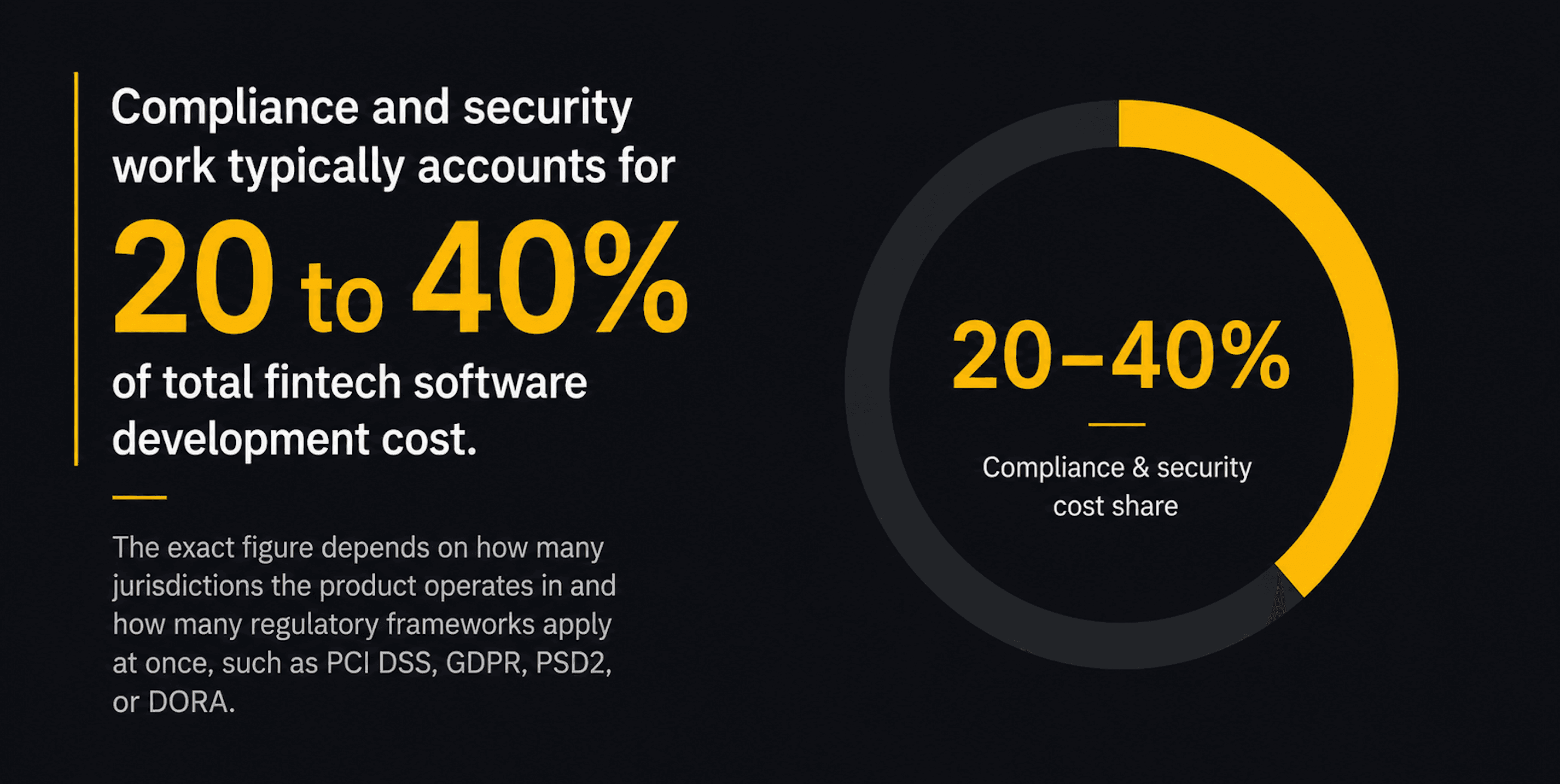
Compliance and security work typically accounts for 20 to 40 percent of total fintech software development cost. The exact figure depends on how many jurisdictions the product operates in and how many regulatory frameworks apply at once, such as PCI DSS, GDPR, PSD2, or DORA.
That spend covers more than a checklist. It includes:
- identity verification and KYC/AML workflows,
- encryption and secure authentication,
- audit-ready transaction logging,
- and the ongoing work of keeping all of it aligned as regulations change.
A product built for one market can often start near the lower end of that range; a product built for regulated operation across the US, UK, and EU should plan for the higher end from the start.
How does developer location affect cost?
Hourly rates vary sharply by region: roughly $100 to $200+ for US-based teams, $70 to $120 for Western Europe, $50 to $80 for Central and Eastern Europe, and $25 to $50 for parts of Asia. The work itself doesn't change with location, but the total project cost does, often by two to three times between the highest and lowest bands.
This is why many financial businesses use nearshore or offshore team augmentation for fintech builds rather than hiring a fully in-house team from scratch. It keeps senior engineering oversight in place while managing the rate variable directly, rather than treating location as an afterthought once a budget is already set.
Explore case studies covering technology solutions, engineering, and team augmentation.
See how we solve real business challengesWhat are the hidden costs after launch?
Plan for ongoing costs of roughly 15 to 25 percent of the original build cost per year after launch. That figure typically breaks down into:
- Third-party API fees for payment processors, credit bureaus, or KYC/AML vendors, usually billed per transaction or per lookup
- Recurring security audits and penetration testing, often required annually for compliance renewal
- Cloud hosting and infrastructure scaling as transaction volume grows past initial estimates
- Ongoing compliance work as regulations change, including reporting format updates and new jurisdiction requirements
Teams that budget only for the initial build tend to get caught by this line item in year one. Building it into the original budget avoids a scramble six to twelve months after launch.
How do you get an accurate eestimate?
A real estimate needs four inputs before anyone can quote a number with confidence:
- which markets and regulatory frameworks apply,
- expected transaction volume,
- which existing systems the product needs to integrate with (core banking, payment processors, credit bureaus, KYC/AML providers),
- and whether compliance needs to be built in from day one or layered on later.
At AI Engineering by Grid Dynamics, financial services engagements typically start with exactly this kind of scoping conversation, because compliance-grade architecture for financial data is not something to retrofit after the fact. Our Risk & Compliance Platform and financial services team augmentation model are built around this reality: bitemporal, audit-ready data infrastructure from the start, delivered through dedicated engineering teams sized to the actual scope of the build.
Methodology and sources
The cost ranges in this guide come from a review of publicly published fintech and financial software development cost guides from multiple firms serving the sector, current as of mid-2026, cross-checked against typical hourly rate bands by development region. They're presented as ranges rather than fixed prices because actual cost depends on the specific scope, integrations, and compliance requirements of each project. Treat these figures as planning benchmarks for an early-stage budget conversation, not a substitute for a project-specific quote.
FAQ
How much does it cost to build a fintech MVP?
A fintech MVP with core features, a single platform, and basic compliance for one market typically costs $30,000 to $80,000. The final number depends on which features are included in that first release and how much third-party integration is required even at MVP stage.
Why is fintech software more expensive than regular app development?
Fintech software has to handle real money movement and personal financial data correctly under regulatory scrutiny, which most consumer apps don't. That adds compliance work, stricter security architecture, and integration requirements with banking and payment systems that a typical app never touches.
What percentage of a fintech budget goes to compliance and security?
Compliance and security typically account for 20 to 40 percent of total project cost. Products operating across multiple regulatory jurisdictions tend to sit at the higher end of that range.
How long does fintech software development typically take?
An MVP generally takes three to six months. A mid-scope platform with multiple integrations and multi-market compliance usually takes six to twelve months, and enterprise-grade platforms can take a year or more depending on the number of core system integrations involved.
Should a financial business build in-house or outsource fintech development?
Most financial businesses use a mix: in-house product and compliance leadership, paired with an outsourced or team-augmented engineering group for the build itself. This keeps regulatory decisions close to the business while managing engineering cost and access to specialized fintech development skills.